Living Daily for Jesus

I have found it challenging to define what it looks like daily, to live as a Christian. Perhaps that’s because being a believer in Jesus Christ is not something I do, but rather it’s who I am. Who I am does however, directly affect what I do. Being a Christian doesn’t simply dictate how I spend the first few hours of my Sunday morning, rather the good news of the gospel affects every aspect of my life. As a believer in Jesus Christ I do not reluctantly follow a set of rules or try to check off all the boxes to earn God’s favor. I serve and obey a God who loved me first. Obedience to God is how I show God I love him.

When talking about how Gospel doctrine creates Gospel culture, I love what Ray Ortlund says:

“That message (the gospel) does not hang in mid-air as an abstraction. It is not merely a concept. That message becomes embodied in us. We not only believe it. We not only receive it. We start to look like it.”

In other words, “this is so much more than saying you believe in Jesus or that you try to live a moral life. Walking in the truth, or living in truth revealed in Jesus Christ affects everything: our attitudes, flavor of conversations, sexual behavior, use of money and time, tone of our voices, what we watch and listen to, the words we speak. Truth lays down the path on which God calls us to walk.” (Kelly Minter, What Love Is)

When we choose to live gospel-centered lives, we stand out. We look starkly different than the world does (at least we should). I have noticed a pattern in my life. When I spend more time with Jesus, reading His word and conversing with Him, the more I start to think, talk and act like him. The less time I spend with Him, the more I start to resemble the world in my thoughts, words and actions.

To daily live the Christian life means to live intentionally. A gospel-centered life does not just happen accidentally. We are purposeful in how we choose to live. When we make a decision, we ask ourselves how can we honor God in this area of our life, how can we become more like Jesus and point people to him. We can easily fall into our daily rhythms of life without giving it much thought. There is certainly a need to avoid legalism – a dangerous territory of adding things to God’s word and leaving little room for grace and freedom in Christ. However, our family makes decisions intentionally and with conviction because we want to represent Christ and point people to him in every aspect of our lives. We are certainly going to fall short but we try to be wise with our choices and decisions.

Giving God the first fruits with our finances and holding on to our possessions lightly so we can be generous givers are important to us.

We want to shine for Jesus in our workplaces by working hard, having a good attitude, not joining in on the gossip or slandering others.

We evaluate whether or not our sources of entertainment please God. We try to be careful to guard our hearts and minds.

We have precious little time so we try to make the most of it and invest it well.

As a parent, my time with my children is limited. If my boys live under my roof for 18 years, that’s 936 weeks. Or 6,552 days. How do I make sure that I am maximizing these days that I have a primary influence on my kids to disciple them? I have to be intentional about deciding when, how and where to pour the gospel into my children. Discipleship happens on purpose.

One area where I’m trying to be intentional, is when we are in the car. I am no where near perfect in being consistent with this but I have identified this as an important time with my kids. Car rides can be a time of mindless chatter by my six year old who seems to talk just to hear himself talk. Or I can turn the ten minutes we have on the way to school and back each day into a time of singing the memory verse we are working on. Or working through some catechisms. Or if I need to let my boy talk, I can ask him more pointed and specific questions about the gospel and let him talk it out. I often use this as a time to pray aloud with and for my kids. I don’t dictate every minute of every day and I don’t want to be overbearing, but being strategic and meaningful with our lives matters.

Living each day as a Christian should mean that the good news of Jesus Christ has penetrated our lives to the core and it naturally affects everything we say and do.

Gospel-Centered Parenting

Parenting is hard no matter how you slice it. I’m a mother of young children, I still have plenty of time to mess up my kids. I can’t offer you much on the specific how-to’s of parenting. All I can bring to the table is what God has been teaching me and point you back to Him and His word. I can offer young parents the encouragement that I’m right here in the trenches with you. We are going to make mistakes, but praise Jesus for his forgiveness and grace.

The pendulum of how I feel about my parenting ability swings from one extreme to the other. One minute I think I’ve got this thing under control and I’m rocking it and the next minute I feel like a big fat incapable failure. I tend to lean more towards to failure side though. I regularly feel like I have no clue what I’m doing. Despite how I feel at any given moment, here’s the thing I’ve come to believe:

God cares less about the latest techniques, trends and theories and more about whether or not we are consistently preaching the good news of the gospel to our kids.

I’m not discrediting all the helpful books, blogs, counselors, psychologists and podcasts. I read and listen to those often. I’m cautioning us to not get so caught up in what everyone else is telling us and trying “new” things that we miss the most important thing. Many parenting resources and many of us tend to focus more on demanding good behavior from our kids and less on making sure our kids understand the good news. I see this tendency in myself and in many other parents. Of course I want my kids to be kind, respectful and have manners. Those things are important. We should talk about and teach our kids God’s commands and laws as we sit at home and as we walk along the road (Deuteronomy 6:7). I would argue however, that head knowledge and good behavior are of little value if we aren’t seeing our kids have a heart transformation. And heart transformation is only going to come when our kids recognize their sin, their need for a savior and know the love of a God who provided the propitiation for their sin. The bottom line for me is, I want to raise kids who love God with all their heart, soul and mind and love their neighbor as themselves (Matthew 22:37-39). Love God. Love others. If my kids learn that, everything else will fall into place.

I appreciate what Jack Klumpenhower points out in his book Show Them Jesus. In the book of Luke, Zechariah was found to be righteous before God, obeying all of God’s commands. (Luke 1:6). But despite being an obedient priest, when he came face to face with the angel of the Lord and was told his wife would have a baby and this child would help prepare the way of the Lord, Zechariah failed the test. When he responded by asking for a sign, it showed that he did not believe. And he was silenced until the birth of his son because of his unbelief.  “Zechariah’s righteous lifestyle mattered little once he showed his unbelief. He left the temple mute.” So our own kids, our own “little Zechariahs,” need “to hear that the good news came to a churchy guy.” “Where Zechariah ended up is where we want our churchiest kids to end up. The path to that spot in the heart runs through the good news.” It’s not about being a good Christian and doing all the right things, it’s about what Christ has already done for us on the cross and how we respond to it. Is that what we’re teaching our kids?

While good behavior can’t be our only focus, we do need our kids to be well-disciplined. I am no scholar but here’s something I find really interesting.

Discipline comes from the Latin root disciplina which means teaching, training, self-control and forming healthy habits. And disciplina comes from the Latin word discipulus which is where we get the English word disciple. You’re not going to get to disciplina without discipulus. The root of discipline is disciple.

As wise parents or teachers who want to make disciples of Jesus Christ, perhaps the focus of our discipline should be less about strict rules and anger (with punishment resulting in short-term behavior adjustment) and more about loving correction and guidance (seeking lasting heart transformation). We have to help our kids understand that obedience to God comes from a heart that loves Him because He first loved us (1 John 4:19). While there are naturally consequences for actions, we should resist the urge to only address and correct our kid’s behavior. We have to remember to point out the sin, but point them to the cross of Jesus with our very next breath. Remind your kids that Jesus loves them and will forgive them.

We are not promised that just because we bring our kids up in the way of the Lord that they will choose to follow Him. I can take comfort though, in knowing that I will not answer to God for my kids good behavior or how they will one day choose to live their life. I will answer for how faithful I am to preach the good news to them and how I’ve guided them towards being a disciple. While I pray diligently that they will put their faith in Jesus, I can rest in knowing that it’s ultimately the Holy Spirit’s work in their lives that will draw them to God – and it’s truly a work that only He can do.

Excellence in Ministry

As a parent, I teach my children that no matter what they do, they need to do it well. Whether they are making their bed, writing a story for school or raking leaves in the yard, I encourage them to do their best work. I tell them it’s partly because they are representing our family, but even bigger than that, they are representing Christ. Even when we’re doing things that seem trivial, we are to work as if we’re working for the Lord, not for man (Colossians 3:23). Since we are followers of Jesus, we should do our work and ministry with excellence. I find it interesting that even Solomon who wrote that everything is meaningless still didn’t endorse laziness because he said, “Whatever your hands find to do, do with all your strength…” (Ecclesiastes 9:10)

What is excellence, though? In my own personal theological thesaurus, excellence would be listed as an antonym of mediocrity, average or stagnant. But let’s be clear. Excellence is not perfection. Edwin Bliss said, “The pursuit of excellence is gratifying and healthy. The pursuit of perfection is frustrating, neurotic, and a terrible waste of time.” We’re never going to achieve perfection on planet earth, but it is biblical to desire and strive toward excellence. Excellence in ministry is also not being superior to everyone else and being the best. Excellence is being or doing your best and getting better each day. There will always be ways to improve and see growth.

Many people are capable of leading a sufficient ministry. There are plenty of great kid’s ministry leaders. A lot of pastors have decent student ministries. I don’t believe we should settle for just what is needed to get by in ministry. We should raise the bar and challenge the status quo as we strive for excellence. Excellence can be achieved no matter what your budget is, no matter how large your facilities are or how many volunteers you have serving with you.

But WHY? Why should we strive for excellence? What is our motivation?
1 Corinthians 10:31 says “So whether you eat or drink, or whatever you do, do everything for the glory of God.”

Doing ministry with excellence shouldn’t be for the approval of others or to impress anyone. It should be so that God receives all the glory. Excellence is not even really our ultimate goal. Excellence should actually be how we want to get to our goal. It has been said that excellence is not a destination, it is a continual process of transformation into who God wants you to be. I have found myself saying over and over the last few years that everything we do in kid’s ministry should be so that we can see hearts and lives change. As we do all the little things with intentionality and do them well, we will hopefully see the end result being a ministry that is impacting kid’s for eternity.

The pursuit of excellence is going to look a little different for each person and each ministry. Striving for excellence in kid’s ministry will mean that we create a safe place for kids, a place where they know they are loved and accepted and a place where they hear truth and hope every time they walk in our doors. We strive for excellence in ministry so that as we point kids to Jesus every week, the truth of the gospel will sink deep in their hearts and minds and it will begin to change to their lives.

If something is worth doing, it’s worth doing well. As Paul says in Colossians 3:17, “And whatever you do or say, do it as a representative of the Lord Jesus, giving thanks through Him to God the Father.” If we’re representing God, we should do things well for His glory. When we do the little things with excellence, it will add up to being a whole ministry of excellence.

God is a God of excellence. I recently read through the book of Exodus. I was fascinated with the intricate details that God required during the building of the tabernacle. It was not sufficient to put four poles on the ground, throw a sheet over it and call it a tent of meeting. There were very specific measurements, specific materials to be used and it required skilled laborers that God equipped to build this thing. It was awesome. It was beautiful. It was excellent. The how and the why are important to God. Details matter.

What does excellence look like practically? It looks like hard work, because it is. It will mean seeking out training for yourself and offering training for others, reading, researching, planning meetings and hours in prayer.

It may mean that you reduce the number of things you are trying to do. Even eliminating good things that stand in the way of better things. I have had to evaluate my own life multiple times to see if I need to let some things go. It is better to do a few things well than to try to do many things and do them mediocre.

Doing ministry with excellence means looking at every aspect of your ministry and making sure everything is done well. For example in kid’s ministry it means each week you are making sure your safety and security is top notch, your signage and check-in process is clear and efficient, rooms are clean and uncluttered, teachers are there early and prepared for kids to arrive, your snacks are allergy free, you maintain open and clear communication with parents throughout the week and that your curriculum is gospel-centered. It is a lot to think about. But if we focus on just one of those areas, the other areas will lack. Excellence will require a big picture vision and zoomed in focus on individual parts. It requires commitment and sacrifice. It requires time.

It is freeing to remember that we can’t achieve excellence in our own strength. As we rely on Him, God gives us the passion and the endurance. It should be all for His glory.

One church, One body

As a healthcare worker, I have always loved studying the human body and learning how the individual parts work. Every part has a specific function but all the parts have to work together in order to have a healthy body. So I can appreciate the text in the New Testament that says the church is the body of Christ. Believers all have a specific role and function in the church. If one part of the body is not working as it should, the whole body suffers.

Often in the church, we view our pastors and staff as the ones who not only lead our church, but as the ones who do most of the work of ministry as well. I think the apostle Paul has something different to say.

In the first half of his letter to the church in Ephesus, Paul spends time talking about how because of His grace, God has gifted the believer with “every spiritual blessing in the heavens.” We have received things like adoption into the family of God, an inheritance, forgiveness for our sins, wisdom, understanding, the Holy Spirit, new life in Christ Jesus and the list goes on.

Starting in chapter four, Paul changes the tone of his letter. The chapter starts with the word, “therefore.” It’s common for Paul to offer an “If… Then…” statement throughout his epistles. He gives the reader not just a command, but the reason why. It’s helpful to understand the heart, the meaning or the protection behind the mandate.

Because of all that God has given us, the church is therefore urged to live worthy of the calling it has received (vs 1.) In verse four he stresses that the church is one body. He goes on to talk about how grace is given to each believer according to the measure of Christ’s gift. Each one of us is given a gift and He’s “equipping the saints for the work of ministry.” Keep reading and you see it again. What is the reason we are gifted and equipped? To build up the body of Christ, until we all reach unity in the faith and in the knowledge of God’s Son, growing into maturity. (verses 12-13).

When every part is working as designed and working together, we build the body up. All of us have to play our part. There are many who approach church from a consumer standpoint. They ask, “What can the church do for me? Will this church feed me? Is this a place I can drop-off my kids and let someone else disciple them?”

We have to get away from the idea that church is about us. It’s not about our preferences or our opinions. The greater responsibility of the church is to make disciples of Jesus Christ as we pursue Him together as one body of believers.

If we take an honest look at our churches, we often see that we have segregated ourselves out into individual ministries. We have kids ministry, student ministry, women’s ministry, senior ministry and everyone is doing ministry separately. Many of these ministries are doing fantastic things for the kingdom. But rarely are our ministries integrated and working together. The reality is that the kid’s ministry is not always preparing kids to enter into the student ministry. And students are graduating and many of them are leaving the church, even if for only a season (See detailed numbers here). Maybe if we help them connect to the larger church and help them see that they are a vital part of the body, we would see fewer of them leave.

What does it look like to practically work towards a church that is truly one body? To start with, I think we can:

  • Equip kids instead of entertain kids: teach biblical literacy, encourage scripture memorization, small group discussions, stop giving pat answers to their hard questions, be intentional about making sure our activities, crafts, songs and games are pointing kids back to what we’re teaching.
  • Preach the gospel instead of teach moralism: it’s not what we can do to earn God’s approval or love, it’s about what Jesus has already done on the cross.
  • Partner with parents to make disciples of Jesus Christ: while parents have the primary role of discipleship for their children, the church has a responsibility to come alongside them.
  • Help kids and students see their gifts and passions and get them plugged into the church serving somewhere: if they are believers, kids and students have also been gifted by God to serve the body – as you see areas of giftedness in their life, speak words of encouragement to them, help them see that they are valuable members and are needed in the body.
  • Bring kids into our missions efforts and give families opportunities to serve together: there are many kid friendly opportunities (singing together at a nursing home, baking cookies for neighbors, visiting church members in the hospital, etc)
  • Help adults see that investing in a young person personally and spiritually is a major factor in helping young adults stay in church (see article above).

It is unfair and unreasonable to expect the pastors to have the sole responsibility to disciple and care for the needs of the entire body. We have not been given gifts so that we can hoard them or build up our own kingdom. We have each been uniquely gifted by Jesus for a specific purpose to help build up the church. If we are going to be church contributors instead of church consumers, we have to get involved in the ministry. We need a church where the equipped saints are all serving, including kids and students. When we integrate our ministries we can build up the body of Christ, until we all reach unity in the faith and in the knowledge of God’s Son, growing into maturity.

What if instead of dismissing kids from worship, we invite them in?

Children in worship services. Oh I know, this is a sensitive subject for people. Some of us are quite vocal with our opinions about this. And I’m no expert. I am a mom of young children and a kids ministry volunteer. I’ve been observing for a while and I want to pose something for parents and kid’s ministry leaders to consider.

Every church does this a little bit different and for different reasons. Some churches keep children in the worship service the entire time, some churches have an entirely separate service for the children and some churches are somewhere in between. My church falls in the “somewhere in between” category. Maybe it makes us feel a little better if we’re not on either extreme and we give this program a cute name. I don’t know. But we dismiss the younger elementary children after the singing and right before the sermon starts. Some churches want upbeat and louder music to entertain the children. Some churches want simpler, kid level sermons. Some church’s goal is to prepare kids to be able to “graduate” to big church after they know what to expect and how to behave. And I will say this, I think God can and does work in each and every one of these various scenarios.

If you keep reading this, you will no doubt disagree with me on some (or many) points, if you haven’t already. And that’s ok. I think it’s good, even healthy to question and challenge our own philosophy on children’s discipleship and evaluate our practices and programs along the way.

It is fairly common practice to keep preschool age and younger children in the nursery during the worship service. I’m not necessarily challenging that. But don’t misunderstand. I’m never in favor of it just being “childcare.” I am in support of a time, that if organized and structured well, can be a great teaching time for those children. (I know, I know, that requires effort and prep work. Another post for another day, Lindsey. Moving on…) As my oldest approached entering Kindergarten, I started asking some fellow moms what they did with their children during the worship service. The majority of them send their children to some type of children’s church. But their reasons for doing so is what grieved my heart.

“I’m with these kids all week. I need a break.”

“All they do is wiggle and roll around on the floor. It’s completely distracting.”

“They need to learn how to sit still and behave in church and then they can come in with me.”

“The sermon is way over their head. They need to be taught on their level.”

“It’s a privilege to sit in ‘big church.’ They’ll appreciate it more when they earn it as they get older.”

So then I started asking different questions. I meant well. But I think I unintentionally caused offence. I earnestly wanted to know what exactly the kids do or hear in children’s church. Some of the moms couldn’t give me an answer because they honestly didn’t know. Some told me they didn’t care as long as their kids were alive when they went to pick them up. Some told me they watch a movie and play games. I had one mom tell me that I wouldn’t be so concerned about it when my kid got to Kindergarten and I tried to keep him in the service. She suggested that I’d last one week of him in the service with me and then send him off to children’s church. Interesting.

When it came time to decide, my husband and I decided to keep our son in the worship service with us. Is there some wiggling? Yes. Is there some whispering? Yes. Does he occasionally (loudly) answer the rhetorical questions asked by the pastor? Yes. Is there continual guidance and correction from my husband and I throughout the service? Yes. Do we regret it for one second? No.

In fact, the first time he got to experience watching us participate in the Lord’s Supper, I knew there was great value in having him in worship with us. That one event sparked a conversation with my five year old that I will cherish forever. I sat and gently whispered to him throughout the Lord’s Supper. I quietly explained what each element meant, why we participate in this sacred reminder and even why he couldn’t participate yet. I left church that day with a heart filled with gratitude to my Savior. What a privilege to be the one to talk my son through his first Lord’s Supper experience. I wouldn’t have wanted to hand off that responsibility for anything in this world.

Albert Mohler, President of Southern Baptist Theological Seminary said this:

“You should see people sitting in pews who’s feet can not touch the floor. And we should in church, welcome the wiggling and the squirming and we should hope that what is happening is that the word of God is reaching those hearts in ways those children do not even recognize. They are speaking as children, they are thinking as children, they are reasoning as children. But the word of God can reach where we can not go.”

(https://twitter.com/SBTS/status/967212944546324480)

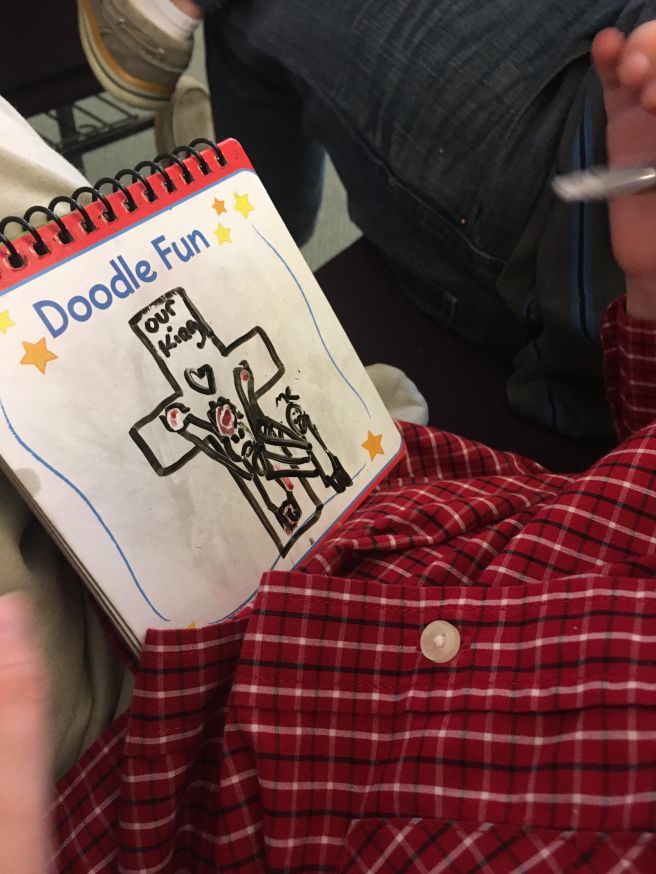
That last sentence is the perfect way to describe what happened during the worship service at my church yesterday. My son has his own Bible that he uses to try to follow along as scripture is read during the service. However, at some point during the preaching time, he inevitably reaches for his “worship bag.” You know, the bag with the mini white board doodle book and dry erase markers. The snack. Or whatever else I’ve thrown in that day. I have nothing against doodling in church. For some kids, (and let’s be serious, some adults too) they listen even better when they are allowed to move and wiggle a little bit. I have never expected my child to sit perfectly still in silence for the entire service. But back to yesterday. Our pastor was teaching on the crucifixion of Jesus in preparation for Easter. His message had gripped my heart with such love and gratitude and awe for what Christ has done for me that I realized I hadn’t glanced over to check on my child in a few minutes. When I did look over, I realized he had been doodling. Wondering what he had come up with this time, I looked a little closer. This is what I saw:
mason's cross

I felt my husband looking at me but I couldn’t look back at him because I was on the brink of tears. As my boy was listening, he illustrated Jesus on the cross. And he put himself standing in front of Jesus. But instead of putting “King of the Jews” above Jesus’ head, he put “Our King.” Oh how right you are my dear son. Jesus is our King. And we crucified him on that cross. I don’t think he fully understands the weight of what he drew or wrote yesterday. But I do think that the Word of God reached a place in his heart yesterday where I couldn’t go.

I think in order for the church as a whole to invite children into their worship services, we have to change. We need not just a heart of love for the children, but a heart willing to sacrifice our own comforts. Parents will have to step up and embrace their God-given role of primary disciple-maker of their children. We have to stop being a “drop-off society” as Merrie Johnson calls us. We are a society where many kids are dropped-off at church or in their classrooms and parents want the church to do the primary discipling of their children.

In an article titled My kid doesn’t “get” anything out of Church,  Christina Embree says, “Thus, there must be something to it, even if what they (children) get out of church is not the same as what we adults “get” out of attending church service.”

Christina goes on to describe what children do get out of attending a worship service. Don’t miss this. Children get SEEN, they get to SEE and they get EXPERIENCE. She sums up by saying, “Parents should be prepared for the inevitable eye rolls of boredom or occasional acting out and having to do follow-up after the service to reinforce what was taught. But I firmly believe these frustrations of the moment are far less painful than the alternative – a generation who is unknown, disengaged, and separated from the larger body of Christ. By giving our children a place to be seen, to see, and to experience their faith with others, we give them so much more – we give them a foundation for their faith that will leave lasting impressions on their heart.”

Preach on, girl.

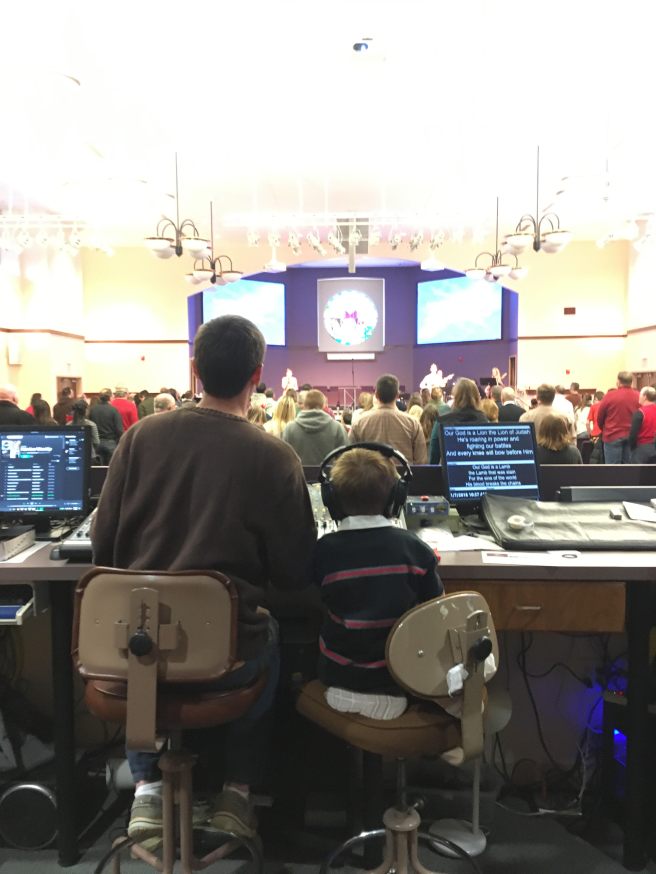
I would even add that children can learn how to SERVE in church. I have talked about this many times before but my husband and I are huge advocates for our kids serving with us. Not just hearing us talk about it or even just seeing us doing it. But letting them be a part of it and serving with us. Or even finding their own way to serve. Both of my kids love coming to church early with me on Sunday mornings and helping me set up my classroom. And one of my oldest’s favorite things to do is serve in the sound booth with his daddy.
kyle and mason

Parents and grandparents send their kids to children’s church for all different reasons. But if it happens to be for one of those above reasons that other mom’s have given me, I would urge you to challenge your way of thinking. You never know, being in corporate worship with the entire congregation could in fact, make an eternal impact on your children. I believe it’s at least worth considering.


When God reroutes your night

If my spiritual growth was drawn out on an actual line graph, the line would have taken a sharp turn upwards and continued at an exponential rate over the last twelve months. I am amazed at how much the Lord has shown me, taught me, challenged me and changed me over this past year. He has worked in such a way that only He could receive all the glory for it.

I am a planner by nature. I am organized (mostly). I have my i’s dotted and t’s crossed way in advance. I send way too many emails and have way too many reminders set on my phone. Basically, I’m obnoxiously Type A.

This week I had a plan for my Wednesday night kid’s mission group. I was there early, I had everything laid out and organized in the classroom. I was all set! Then the kids showed up… ha. Just kidding… sort of.

I felt like we had been somewhat intense with our teaching the last few weeks so I had chosen some lighter activities for the kids to have some fun this week. Our missionary that we are focusing on this month had shared about the power of our personal testimony. I wanted to make sure the kids understood what a testimony was and discuss some ways they could share theirs with others. It was meant to be a brief introduction conversation before we started our next activity. One of the young girls raised her hand and asked, “Well, what’s your testimony Mrs. Lindsey?” I briefly looked over at my pile of props for the activity and turned back to see her smiling face. I had a choice. Push through with my plans because that’s what was on the schedule tonight. Or scrap the plans and join God where He was working. I’m so glad I chose the later.

I got to pour my heart out again to this sweet group of children. I had the privilege of sharing how God had worked in my life from such a young age to draw me to Himself. And I got to tell these precious ones that the same God who loved me and saved me, loves them and wants a relationship with them too. My co-teacher then piggy-backed off my testimony and shared his too. All I could do was sit in awe at what God was doing in our midst. Thirteen fourth and fifth graders sat wide-eyed and listened intently as we shared the powerful message of the Gospel and our life stories with them. I couldn’t get over it.

I left the room shaking my head after the night was over. Silly me. I had it all planned out, didn’t I? I thought we were just going to do some review fun and keep it simple that night. God had a way better plan. I’m so thankful for those kids who diverted me off the planned route and took a rabbit trail with me that was so special and powerful and more meaningful than anything I could have imagined. I’m still learning. And for that, I am grateful.

Are preschoolers too young to be a part of missions?

If you’ve been around young children for any length of time, my guess is that you have noticed that they are pretty self-centered. It’s not necessarily their fault. During the preschool years it’s especially hard for them to see and understand much outside of their little world. People have served them and taken care of them their whole life. They want what they want, when they want it and they are not likely going to be willing to share much of what they have. They are too young to fully comprehend their sin nature and their need for a Savior. But I believe they are never too young to start talking to them about how much Jesus loves them. And that there are people all over the world that need to hear that good news about Jesus.

I believe we can start now – no matter how young our kids are – with teaching them to hold on to their possessions lightly and be ready to give as they see needs around them. Giving has little to do with how much you give and a lot more to do with the attitude of your heart. This is hard for a lot of adults, so how do we help our children develop generous hearts? This is a work in progress for my family.

This year, I’m trying something new with my own children and the children I teach at church. As Easter approaches, I’m sharing information with my kids about the Annie Armstrong Easter offering. I started with pulling out a map or globe and introducing them to the idea that the world is so much bigger than they can imagine. We’ve looked through a children’s atlas and scrolled through The Google to show them places and people all over the world. We talked about how there are people all over this world that need to hear about Jesus.

My two boys know that their daddy and I have traveled across the ocean to tell people about Jesus. And they watched as some of our best friends sold all their possessions and gave up their American life to move abroad and be missionaries. We pray daily as a family for missionaries that we support financially. On their own level and in their own way, they are starting to grasp the idea of what it means to sacrifice for the sake of the Gospel even though neither one of them have committed their lives to Christ.

Yet they know there is a God who loves them and they know there is a need to tell others about that amazing God. We have to go beyond telling our kids missions is important. We have to go beyond them seeing us doing missions. While those things are significant and necessary, children have to learn why they should be doing missions and how they can be a part of God’s mission.

Since I teach such young preschoolers on Sunday mornings, I wasn’t sure exactly how I should include them or if they’d even understand anything about giving their money to a missions offering. I decided to dive in with an experiment and start planting those seeds of generous giving to God’s work. Since we have been learning about Paul and his missionary journeys over the last couple of months, it was a great segue into talking about the importance of missionary work in today’s world. I gave each of the kids in my class a small money bank filled with candy. I encouraged them to enjoy the candy while they prayed for missionaries. After they finished the candy, they were encouraged to fill their money banks with money for the Annie Armstrong offering. Obviously this required parent participation and support for preschoolers. This was such a perfect way to get parents and whole families involved! One of the little girls in my class helped her mom with some simple chores around the house and earned money for her bank. My three year old made the choice to put some money he was given in the missionary bank instead of his own piggy bank.

After a few weeks, the kids brought back their money jars and we had another short discussion about missionaries and why we were giving money to this offering. We gathered all their little money banks together and prayed for their offering and for the many people that would hear about Jesus because the kids gave their money.

I pray that this simple activity will make a lasting impact on their little hearts. And that these sweet kids will develop generous hearts and want to give to and be a part of God’s mission.

Preaching the gospel to our kids when they mess up

As a mom who messes up on the regular, raising kids who mess up on the regular, I am learning a lot about what it actually looks like to preach the gospel to ourselves. Some days it’s easier than others to give myself grace. It’s even harder sometimes to extend grace to my children. Honestly, I often find that it is easier to show them grace when they sin against me. But when I see them sin against others, there is something inside me that wants to pounce on them like Luke Kuechly tackling a running back in the back field.

My oldest kid messed up pretty bad the other day. He knew he messed up. And I have to assume he was feeling some level of guilt because as soon as he got in the car after school, he said, “Mommy, I have to tell you something.” God Bless America. I immediately got that nauseas feeling and knew I wasn’t going to like what he was about to say. He fessed up to making some pretty rotten choices that day that led to someone else getting hurt. I could not believe (actually I did not want to believe) the evil state of his heart that led to saying and doing what he did that day.

In a matter of seven seconds I felt a range of emotions. Embarrassment that I am the mother of a child who could behave this way. Guilt that I haven’t done enough to make him sweeter and kinder. Anger because he knew better than to act this way. The last thing I felt in that moment was forgiveness and grace.

It took me the rest of our short ride home to gain my composure and get to the point where I could think clearly. And I started thinking about how I have been learning so much about how to practically preach the gospel to myself. I knew I had a choice to make. I could yell and scream and stomp my feet in frustration while ignoring the situation. I could punish my kid for the behavior without really getting to the heart of the issue. Or I could sit and have a gospel centered chat with my boy.

By God’s grace, that day I chose the later. While that is certainly not always the case, this crazy mamma actually made the hard but wise choice that day and I’m so glad I did.

I find that it is easy to preach the gospel to my children when we are at church. Or during family Bible reading and prayer time. Or when I’m in a good mood and feel like it. It’s a whole different ball game to preach the gospel to my children in. real. life. hard. situations.

We had a really great conversation about how yes, what he did was wrong (and there are consequences and apologies that needed to happen), BUT… there is a God who loves my kiddo (and all of us) and will extend grace and forgiveness every single time he messes up. There is a God who loves us so much that he was willing to send His son to rescue us. A God who was willing let his son die on a cross as payment for a debt we owed, yet couldn’t pay ourselves. As my pastor says, we have a savior who didn’t just die for us, he died instead of us. That’s what my boy needed to hear that day, and every day.

We had a really sweet time of prayer and my son asked God to forgive him and he prayed for the kid that he had wronged. The next day as I dropped him off at school, he said, “I’ll remember what you said, mommy.” But really, they are not my words. They are God’s words. They are His promises of grace and love and forgiveness no matter how bad we mess up or how many times we get it wrong. I need the gospel every day. My kids need the gospel every day. And I pray that my children learn to run to Jesus in their sin and shame, because it is there that they will find grace and forgiveness.

I loved singing this reminder in church yesterday:

Where sin runs deep Your grace is more
Where grace is found is where You are
And where You are, Lord, I am free
Holiness is Christ in me

(song lyrics by Matt Maher)

Treasuring God’s Word

I remember as a young girl, receiving a brand new Bible. It was a leather bound, bright magenta colored Bible and I loved it. I proudly carried that Bible with me to church each week. For a while, I vowed to never let it touch the ground. I treasured it because I knew it was special. I knew it was God’s word. And I had a copy of it, all for myself!

In our digital age, printed materials are becoming old fashioned. People have to turn on their Bible instead of open it up. Lately, I can’t help but wonder if we are possibly neglecting passing along to our children how sacred these texts are. I do understand that it’s not the book itself that is precious, but rather the God-breathed words inside.

I have noticed a pattern though. Our Bible story times in our kid’s classes consist of our children watching a four minute video. Or we teach while we play a game. Or we read a summary of a Bible story out of our leader guide. All these things are great ways to reiterate the story and help kids remember what they’ve learned. But what I see instead is, these things are often replacing a Bible teaching time in our kid’s classes. A lot of kid’s leaders don’t actually open a Bible and teach kids out of it. It is possible that I am old fashioned (even as a millennial). I see in my own children, the desire to be entertained. But I have also seen the value in pulling children in really close, opening up a Bible and teaching them from it. Sometimes we don’t give kids enough credit. We think we have to keep them moving constantly, keep church exciting so they won’t get bored or bribe them with treats and candy. Most of them can sit, they do listen and they are learning. So what are we teaching them?

I’m really just asking questions and praying through these convictions. I’m not the expert or a hero here to save the day. I’m not bashing the curriculum or the teachers or offering answers. I do believe it is possible to use different means to get the same final result. As a parent it has been easier to notice how different teaching styles affect what my kids are grasping. I have picked up on certain patterns, which has led me to certain thoughts on how I teach. I’d love to hear other kid’s ministry teachers and leaders thoughts on this.

In the preschool class that I teach, I have felt a personal conviction to not teach from a tablet or a video or a guide. I teach two year olds so I also don’t read directly from my Bible. But I do have it open on my lap as I summarize the story on their level. I draw a little purple heart by the Bible passage I am teaching from that week. I remind them every single week that we are reading from God’s word and that means what we are reading is true. I hold the Bible open and let each of them reach out their sweet little finger and touch the purple heart. I desperately want them to know that when we open that sacred book, it’s important enough to stop and listen. It’s special. I want them to know that what I’m teaching isn’t some made up fairy tale. Or even just a really nice story with a good moral lesson in the end. It’s not Ms. Lindsey’s opinion of what the Bible says either. I want them to know it’s God’s word and it’s the most valuable thing they could ever read.

I’ve had some interesting conversions lately. Someone suggested to me last week that teaching a preschool Bible class is easier than teaching an adult class. I’m going to take a wild guess and say that they have never taught a preschool Bible class. I think the weight of teaching the Bible to any group should bring us to our knees. The responsibility to rightly divide the word of truth is rarely “easy.” I told a good friend the other day that I literally feel like I’m in a battle each week that I teach these precious ones. Each Sunday driving to my church I feel like I’m heading into a battle to fight for the souls of these sweet kiddos. While my lesson is condensed to an appropriate amount of time for my two year old class, we are still teaching the rest of the hour. Against popular belief, we don’t just play in our class and we don’t just love on the kids. It is quite the challenge to make sure every single craft, every single activity, every single song points these kids back to Jesus. And not just back to Jesus, but back to how Jesus was in the story for that day. Back to the truth of what we want these kids to remember that week. We take our designated discipleship hour seriously. You can believe that we are striving to pour truth into these kid’s hearts the whole time. It is an intentional and exhausting effort each week but I wouldn’t do it if I didn’t think it was worth it.

I still bring an actual Bible to church. Often, I do pull up a different translation on my phone and read it parallel to my Bible. I was tempted to let my five year old bring a tablet to church and pull up a digital Bible to follow along during the sermons. But we got him a Bible for Christmas instead. He was so excited when he opened it. I’m pretty sure that was my favorite gift that I gave this year. He picked it up, hugged it against his chest, smiled and said, “My own Bible!” If only every American kindergartner could say that about receiving a Bible. There are so many people around the world that are desperate to get their hands on a Bible in their own language. Are we that desperate to open up our Bibles each day and cling to every word we read?

These are just my own thoughts that I ponder every week. As the statistics and reality of the number of kids that fall away from the church when they graduate weigh heavy on my heart, I can’t help but continually pray about what we need to be doing for our kids while they are little. Is teaching them to treasure God’s Word one of the missing pieces to the puzzle? Are we challenging them to memorize and hide God’s word in their heart so they can run from temptation, choose the right path and have comfort and hope in affliction? Do they understand the big picture that the whole Bible is about Jesus? Do they really know and believe in their hearts “all Scripture is God-breathed and is useful for teaching, rebuking, correcting and training in righteousness, so that the servant of God may be thoroughly equipped for every good work?” I question do I really treasure God’s word? How can I effectively teach something I don’t know myself? I will keep thinking and praying on these things.

This is my story, this is my song

Every year is different. This year the Lord has allowed some unique and very challenging situations for me to walk through. It has often felt like I’m losing way more than I’m winning. Sometimes it felt fake to smile. Sometimes I felt too angry to pray. Too sad to sing. Too scared to move. But I did it anyway.

I clung to Jesus this year and I am so incredibly thankful for His grace. Sometimes I sit with Him and just think about all that has transpired this year. So many random, unrelated hard things and I try my best to piece it all together to even get a glimpse of the big picture. I usually end up shaking my head and saying, “I don’t get it Lord. But you are enough for me and I trust you.

I work with the missions program for elementary age kids at our church on Wednesday nights. The kids are as loud and energetic as they are smart and hilarious. I love it. The other week I got really brave and decided to try a Modge Podge craft with them. (I have since vowed to never do that again.) We were pasting silk leaves and small squares of colored tissue paper onto glass mason jars. The jars were basically just a sticky, gloopy, white mess. The kids would kind of tilt their heads and look at their jar, look at me with scrunched up eyebrows and ask “Is this what it’s supposed to look like?” I had to explain over and over again that it wasn’t finished yet. Once the glue dried, it would be clear. Then we wouldn’t see the mess any more, we would see the beautiful paper underneath. And when we put a light inside the jar, it would be even more beautiful. It was so hard for them to understand but most of them would shrug their shoulders and have the “if you say so” attitude.

The next day, the jars were just as I had said. They were all dried and now they were a beautiful masterpiece! Since that moment, I’ve had several times of reflection over those silly jars. I feel like I’m one of those jars still in the process of being made. God has given me some unexpected and scary challenges this year. It’s like he places a piece of tissue paper on me and slathers some Modge Podge on top. It’s sticky and messy and ugly. But I get through it and think the pretty colors are finally starting to shine through, only to realize the artist isn’t done yet. He slaps on another piece of paper and more Modge Podge. Over and over again this has been my year. One trial after the other.

For the most part, I have clung tight to my Lord and trusted Him because I know He is FOR me. Everything is for my good and His glory. At this point in the process, I still feel like a sticky, goopy mess. But when He is done with me, I’m going to be beautiful. Each layer he adds will bring more color, more beauty, more value.

In moments of weakness it’s easy to be overwhelmed with the weight of it all. It’s often in those moments, I start listing all of the things that are good and right and true in my life. Often out loud, I start praising God for all He has done for me. (This seems to happen a lot in the car and my children have asked me dozens of times if I’m talking to myself again. *grin*) God has blessed me and my husband and my family with some really amazing things this year. We have served together, traveled together and made some really wonderful memories together. These were moments when the storm clouds opened and the light shone through to my heart. Treasures that I will hold onto forever.

My story isn’t over yet. In fact, there’s still more questions and more medical testing and more waiting to come. God is still working on adding more layers of beauty to my life.

But if I raise my eyes up… beyond the betrayal, beyond the embarrassment, beyond the pain, beyond the loss, beyond the fear, way beyond the confusion… I see the cross. I don’t know the pain and hardships you all are dealing with. Everyone’s trials are a little bit different. But you see, to tell you my story is to tell of Him. Cling to Jesus because I can tell you for sure, he’s a good, good Father.